Product Ingredients (More)

Sodium Lactate – the Fast Release Electron Donor
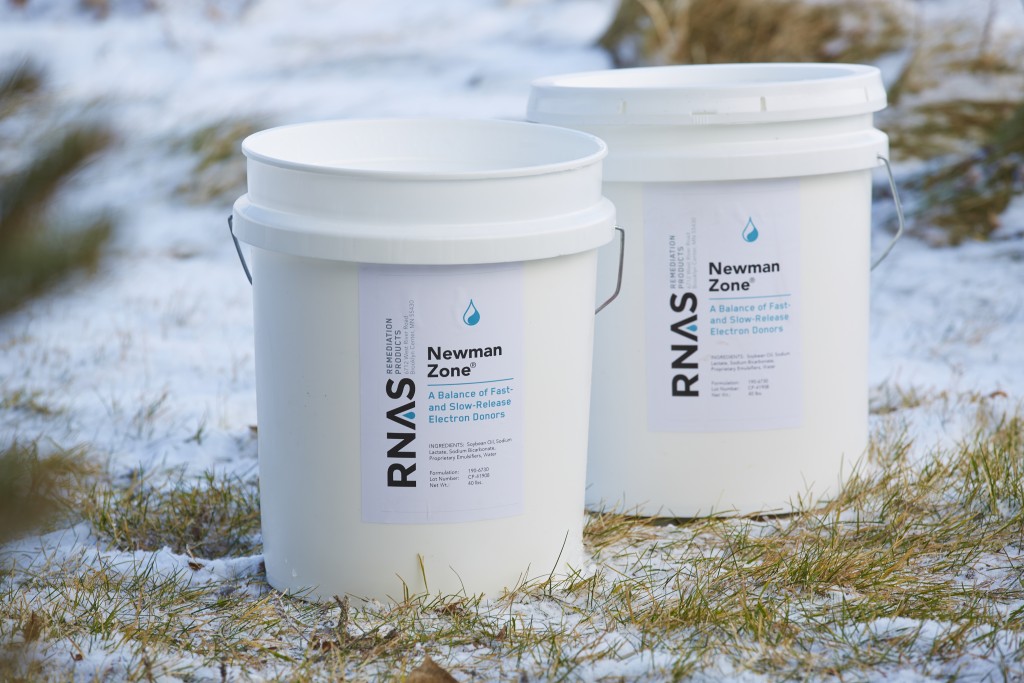
Newman Zone® contains 4% sodium lactate by weight or 40,000 mg/L (31,880 mg/L lactate).  Newman Zone® is normally diluted by a factor of 10 to 100 prior to injection, which results in a concentration of sodium lactate that ranges from 400 to 4,000 mg/L.  Lactate releases approximately 45 grams of hydrogen per kilogram of lactate.  The lactate in Newman Zone® contains 1.8 grams of hydrogen per kilogram of Newman Zone® or about 3.3% of the total available hydrogen equivalents.

Vegetable Oil – the Slow Release Electron Donor
Newman Zone® contains 50% vegetable oil by volume or 46% by weight (460,000 mg/L of vegetable oil).  In most cases the vegetable oil is soybean oil although other vegetable oils such as canola oil may be used for overseas production if desired.  Vegetable oil releases approximately 115 grams of hydrogen per kilogram when it ferments to hydrogen and acetic acid.   The vegetable oil in each kilogram of Newman Zone® contains more than 52.9 grams of hydrogen, or about 96.7% of the total available hydrogen equivalents.

Food Grade Additives and Stabilizing Agents
All food additives have their strengths and weakness and no single surfactant or additive can produce optimal results in a wide range of conditions.  The proprietary blend of surfactants in Newman Zone® creates a stable emulsion over a wide range of pH, temperature, water hardness, and dissolved salt concentrations.

An emulsified vegetable oil (EVO) that uses a single surfactant such as lecithin becomes vulnerable to failure from hard water, high or low pH, high sodium concentrations, and premature adsorption onto soil particles.  Some practitioners have chosen to compensate for the weakness of a single surfactant by providing emulsions with site-specific surfactants, by pre-treatment and post-treatment solutions, etc.  Bench scale testing and multiple-step injections greatly add to the cost and complexity of such methods.  By using better surfactant science Newman Zone® remains stable in a wide variety of environments and allows for a simple one-step injection.
 

Hydrogen Produced by Fermentation Reactions of Common Substrates ( AFCEE, 2004).

Substrate Molecular
Formula
Molecular
Weight
(gm/mole)
Moles of Hydrogen
Produced per
Mole of Substrate
Ratio of Hydrogen
Produced to
Substrate (gm/gm)
Lactate (Lactic Acid) C3H6O3 90.1 2 0.045
Acetate (Acetic Acid) C2H4O 44.1 4 0.183
Butyrate (Butyric Acid) C4H8O2 88.1 2 0.046
Ethanol C2H6O 46.1 2 0.088
Methanol CH4O 32.0 3 0.189
Refined Sugars (Fructose) C6H12O6 180 4 0.045
Complex Sugars (Sucrose) C12H22O11 342 8 0.04
Hydrogen Release Compound® C39H56O39 956 26 0.055
Linoleic Acid (Soybean Oil, Corn Oil, Cotton Oil) C18H32O2 281 16 0.115


Hydrogen Content for Common Organic Substrates ( AFCEE, 2004).

Substrate Molecular
Formula
Molecular
Weight
(gm/mole)
Ratio of Molecular
Weight that is
Hydrogen
Lactate (Lactic Acid) C3H6O3 90.1 0.067
Acetate (Acetic Acid) C2H4O 44.1 0.092
Butyrate (Butyric Acid) C4H8O2 88.1 0.092
Ethanol C2H6O 46.1 0.131
Methanol CH4O 32.0 0.126
Refined Sugars (Fructose) C6H12O6 180 0.067
Complex Sugars (Sucrose) C12H22O11 342 0.065
Hydrogen Release Compound® C39H56O39 956 0.088
Linoleic Acid (Soybean Oil, Corn Oil, Cotton Oil) C18H32O2 281 0.115