
Using Agmark Bulk Tanks
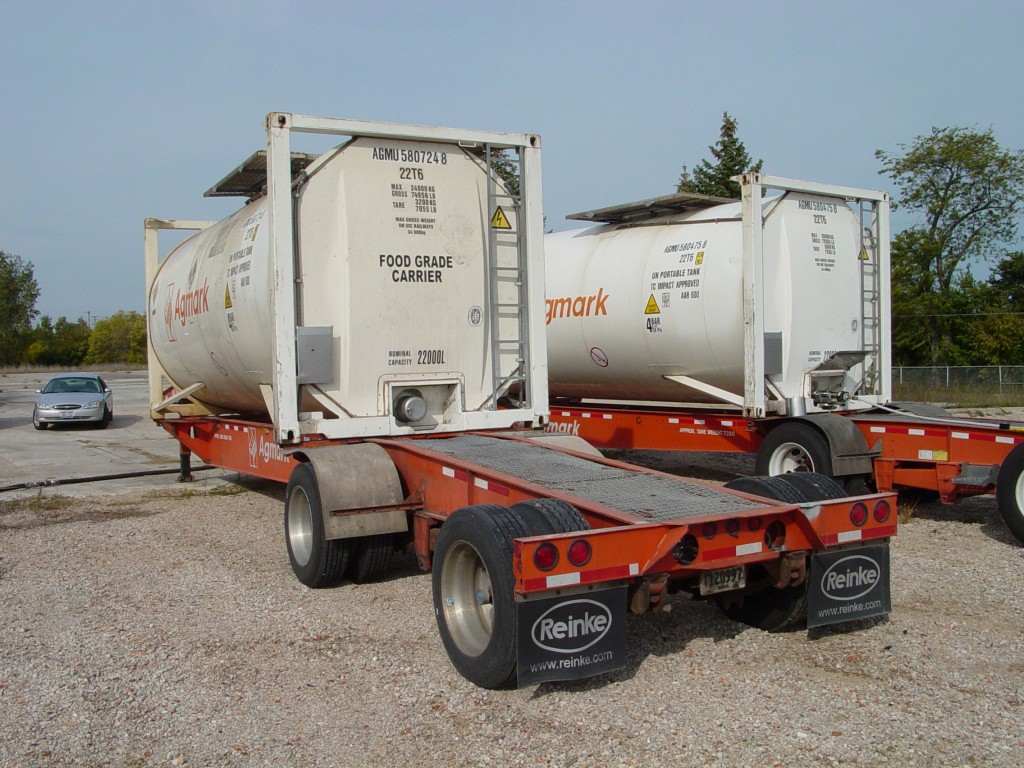
| Here are two Agmark tanks on their trailers. Large sites may require that Newman Zone® be shipped in multiple tanks. In such cases, the first tanks will be shipped as a pair so that there is no down time when the first tank is emptied. Subsequent shipments would be scheduled as on-site usage indicates. Tank and trailer can be rented and left on site for less than $50/day. Click here for more information about Agmark tanks. |
|
| The discharge port is located at the lower rear of the tank and is locked by this steel cover and a tamper-evident seal. |
|
| We can supply this bulk tank adapter kit that will allow you to connect a bulk tank directly to our rental injection equipment and unload Newman Zone® under pressure. Shown are: 1) 3" elbow with a camlock fitting at the discharge end, 2) a wrench for tightening the elbow to the tank discharge port, 3) an adapter that reduces the 3" camlock on the elbow to a 3/4" camlock compatible with the hoses supplied in our rental injection systems, and 4) a gas line valve with a 1/4" automotive coupler plug. Note that the adapter includes a pressure gauge to allow monitoring of the gas pressure you may use to unload the tank and a shut-off valve. |
|
| The protective cover has been removed from the discharge port, our bulk tank adapter kit has been installed, and the discharge valve has been opened. Note that there is a separate brass shutoff valve as part of the adapter kit. |
|
| Some of the Agmark valves have a slow leak. In other cases, the seal between the stainless steel elbow and the Agmark valve has a slow leak. To prevent a mess, use a kitchen dish drain and a 5-gallon pail to catch the drips. |
|
| The Agmark tank will gravity drain, but the discharge rate may slow to an unacceptable rate as the tank empties. In some situations, the bulk tank may be located some distance from the injection equipment, especially if there are a large number of wells that will be injected sequentially. The discharge rate under a gravity head may be too slow if the discharge hose is long. As an example from one site, gravity discharged about 5 gpm from a full tank through a 3/4" vinyl hose six feet in length; discharge dropped to 0.5 gpm when the hose was lengthened to 200 feet. The solution is to charge the tank with compressed air or nitrogen. The tank is rated to hold 30 psi and has a safety relief valve, but 10 to 15 psi is usually sufficient for good flow rates. Our bulk tank adapter kit includes fittings to connect to a 1/4" automotive-type compressed air hose. Please be careful to observe appropriate safety standards and practices when moving and storing compressed gasses on site. |
|
| The compressed gas line attaches to a port on the top of the tank. Note the non-slip platform on the tank. Also note that this platform has narrow walkways, has no fall protection devices, and is higher than the OSHA standard of 6 feet above which fall protection is required. The only operations that require personnel on the tank top are the installation of the gas line valve and hose when a full tank arrives and removal of the valve and hose when the tank is empty. Please be careful to observe appropriate safety standards and practices when personnel are on the tank. |
|
| A blind flange is removed and replaced with the gas line valve included in our bulk tank adapter kit. A compressed gas line can then be directly attached to the valve by the 1/4" automotive coupler plug. |
|
| Include a carpenters level in your tool kit so that you can level the tank/trailer side-to-side and fore-and-aft when it arrives. After a tank has been substantially drained, the jacks at the front of the trailer can be raised to provide a rearward slope that will drain all of the Newman Zone®. |