Product Description

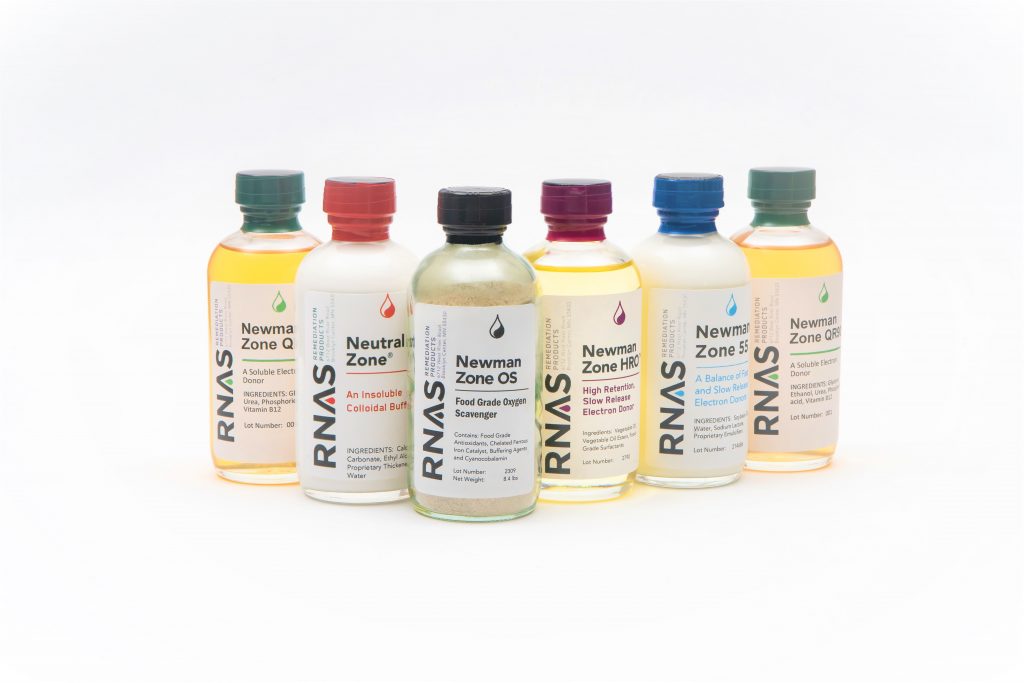
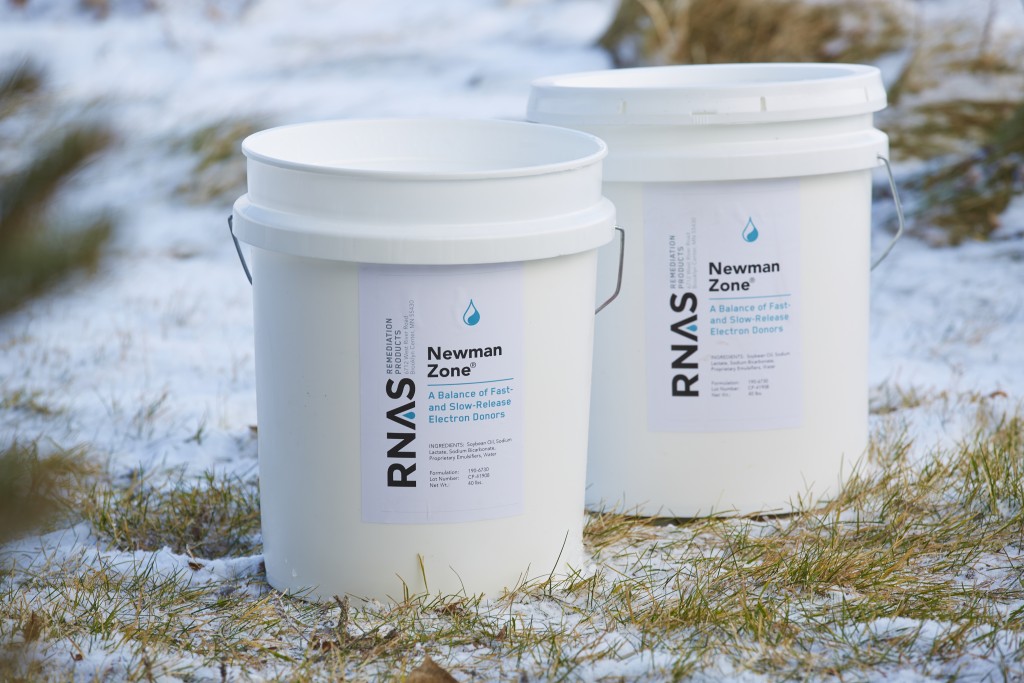
Neutral Zone® is designed to duplicate the buffering capacity of a naturally calcareous soil.  The product is a stable suspension of small-micron to sub-micron particles of calcium carbonate containing more than 500,000 mg/Kg of total alkalinity (as CaCO3 equivalents) and proprietary additives that produce a negative surface charge and make for a stable product (U.S. patent pending).  The calcium carbonate is food grade and the additives are approved as secondary direct additives in food for human consumption. 

Keeping Neutral Zone® in Suspension
Choice of materials is critical for a useful shelf life, where the high concentration of particles tends to keep them suspended, and a useful life during mixing and injection in the field, where the diluted concentration allows the particles to settle.  Settled buffer particles must be avoided in any finely-divide solid buffer material.  They will aggregate into either a viscous gel or a hard, clay-like layer.  Field methods may break up settled material into particles small enough to be entrained in an intake hose, but particle sizes will be much larger that the original material with the likely result being clogged well screens and aquifer pores.  Neutral Zone® is the result of careful selection of calcium carbonate manufacturing methods and particle sizes and proprietary additives. 

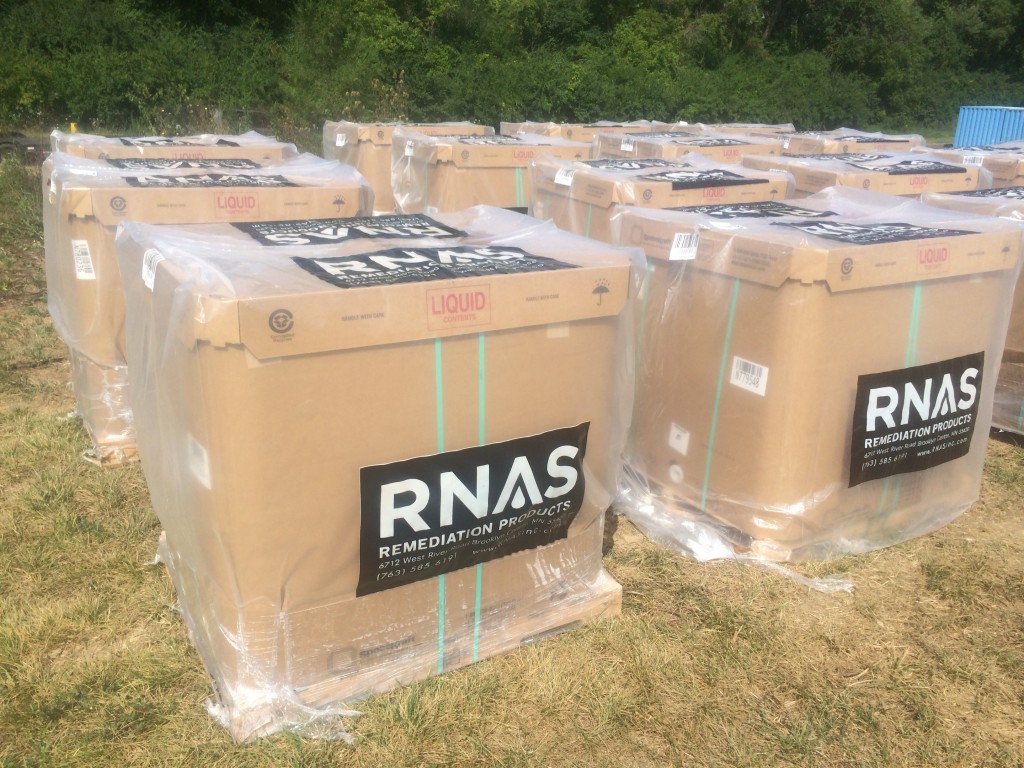
Four 55-gallon drums of prototype material were injected at a site in Massachusetts (one pictured at right).  The concentrated material in two drums showed no supernate and no evidence of settling after five months of storage; two other drums showed only a sheen of supernate and no evidence of settling after one year of storage.  Yet hydrometer testing shows that only a few percent of solids will settle in 24 hours after dilution to 50 g solids/l as per ASTM standard D-422 (Graph at right).

Mobility During Injection vs. Subsequent Retention
As with the use of an electron donor, distribution of a buffer material is critical to a successful remediation project.  Ideally, the buffer would move significant distances from injection points, yet have a uniform concentration throughout the area of influence.  Soluble buffers are commonly lost within relatively short periods of time as a result of advective ground water flow.  An insoluble solid buffer would have no value if it cannot be moved a significant distance from injection wells into an aquifer. 

The desired mobility of Neutral Zone® is based on small micron to sub-micron particles and additives that maintain a negative zeta potential.  Colloidal buffer systems with a low solubility (10-20 mg/l for CaCO3) can be transported significant distances in the subsurface, yet can also have substantial retention in the soil or aquifer after injection.   The insoluble calcium carbonate dissolves primarily by contact with the acidity of the environment and the maximum pH is limited by the generation of bicarbonate to a value of 8.34 whereas highly soluble buffers can create adversely high pH near injection points (>13.0 for potassium hydroxide, for example).

Laboratory testing and preliminary results from several field applications show that concentrations of 0.5% to 10% solids move easily through clean fine sand at a ground water velocity of ~50 feet per day.  This velocity is much higher than would be encountered under ambient conditions, but would commonly be created during injection.  Useful amounts of solids (>1.0 mg CaCO3/gm soil) were retained when test columns were flushed with water at a velocity of ~8 feet per day, similar to the fastest ground water flow that might be encountered under ambient conditions.  Hence, preliminary results indicate that useful amounts of Neutral Zone® can be moved useful distances from injection points and yet be retained where desired at even the fastest ambient ground water flow velocities

Preventing Permeability Loss and Screen Clogging
Potential changes in aquifer permeability was tested in the laboratory.  Buffer concentrations ranging from 0.5% to 10% solids were tested in columns of clean fine sand.  As expected, permeability decreased in proportional to the amount of solids that were injected.  The permeability decrease caused by the highest buffer concentration was less than the variation in initial permeabilities of otherwise identically prepared specimens (<45%).  Subsequent flushing with clean water significantly reduced the permeability loss (2-15%, Graph at right).


Photomicrograph of Dilute Neutral Zone®
(400x magnification)